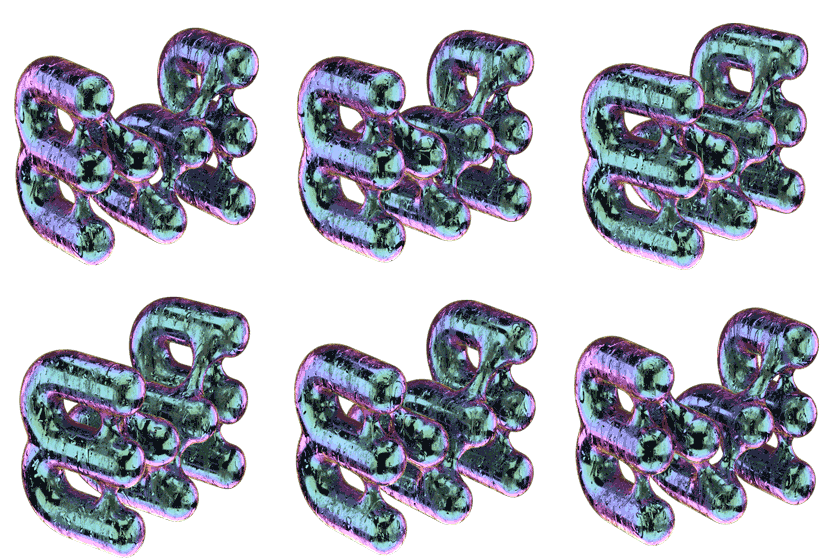


The Laughter of Medusa
Lucile Boiron, Marilou Poncin, Lucie Rosická,Kateřina Vincourová
Curators: Richard & Lenka Bakes
28. 5. – 4. 7. 2026
Opening: 28. 5. 18:00
Centre tchèque de Paris
She has deep, piercing green snake-like eyes, set in the angular features of an ancient bust. She braids her long dark hair into thick plaits, which sway around her tall, slender figure as she walks, as if they were coming to life. She is both serene and untamable. At least, that is how the tales describe her. She is three thousand years old ; for all that time, she has been whispering in women’s ears all over the world and teaching them to laugh. But no living man has yet laid eyes on her — and anyone who might have caught a glimpse of her in the past would have turned to stone.
Medusa and her message continue to challenge and captivate us, even centuries later. Her character, in both ancient and modern tales, embodies a powerful, even uncontrollable, feminine force that patriarchal society strives to suppress. In her essay « The Laugh of the Medusa » (1975), Hélène Cixous asserts that women must write with their bodies, that writing is a return to the body that has been taken from them: “Write yourself: your body must make itself heard.”
This call resonates throughout the works of four artists from different generations and backgrounds, whose works come together in this exhibition: Kateřina Vincourová, Lucie Králík Rosická, Marilou Poncin and Lucile Boiron.
Kateřina Vincourová (1968) is one of the leading figures in contemporary Czech art. Since the 1990s, her intermedia approach in the fields of installation and object art have undergone a fundamental development. The artist’s object, Medusa, opens up the conceptual space of the exhibition and invites us into its world. Vincourová transforms the archetypal figure of Greek mythology into a projection screen for the inner state of mind of the audience. She invites us to wonder: who and what is the mythical Medusa in our eyes today?
“A woman must write herself: she must write about women, and she must encourage women to devote themselves to writing, from which they have been so violently diverted as from their own bodies, for the same reasons, according to the same rule, with the same pernicious intent.”
(Hélène Cixous, The Laugh of the Medusa, L’Arc, 1975)
Cixous writes of women as a source for other women, of that ‘mother’s milk’ which remains within each of us as a latent force of transmission and care. In Vincourová’s work, this idea becomes a concrete and lived experience: the sisterhood that binds her to the artists with whom she has exhibited in the Maisons des femmes, as well as the motherhood of her adult twin daughters. Her works embody her experience of female memory and speak of the body without needing to depict it explicitly. Vincourová works with the body through its traces, its shells and its remnants: an inflatable bag as a refuge, rows of silicone faces that are both alluring and frightening, delicate representations of everyday situations. Tiny glimpses of existence in which the full weight and tenderness of the female experience are concealed. In the past, the female body was primarily defined by the male gaze, art, the media, and advertising. Today, women are able, to a greater extent, to shape their own image, but this process remains subject to new forms of control: algorithms, norms and the need for recognition from others. The tension between freedom of expression and the pressure to present oneself results in a dynamic in which the body once again becomes a field of negotiation. The young generation of female authors each addresses this question in their own way: where does self-expression end and self-censorship begin?
In her photographs, Lucile Boiron (1990) captures the bodies of the women in her own family – her mother, her sister, her daughter – as organic, ever-changing matter, where the skin ceases to act as a boundary and becomes a permeable membrane between the inside and the outside. She is interested in exploring which representations of the female body society accepts and sexualises, and which ones disturb it or are deemed unacceptable. This distinction speaks volumes about the question of who the female body truly belongs to and who has the right to determine the boundaries of its visibility.
Marilou Poncin (1992) creates representations of the female body inhabiting the digital space: her works feature cam girls, avatars and love dolls – female figures drawn from the collective digital imagination. They explore how modern technologies construct new fantasies and how the male gaze is constantly rewritten through them. Cixous warned us that patriarchal culture had trapped women “between two terrifying myths: Medusa and the abyss”. Poncin shows that the digital age has not abolished this mechanism, but has simply
given it a new face, smoother and more transparent, and all the more difficult to recognise.
Lucie Králík Rosická (1998) takes the digital image of the female body and returns it to a traditional feminine expression through embroidery. Her textile images emerge from intimate, even sexually charged selfies; yet upon closer inspection, they prove to be a statement about corporeality without idealization: polycystic ovary syndrome, cellulite, postpartum. These images, which resemble an invitation, are in reality a mirror. And the mirror, as we know, turns to stone those who gaze into it with false expectations. Four artists, four generations and four mediums, united by a shared gesture: the female body as a terrain upon which a constant struggle rages over who tells its story.
“Medusa is not mortal. She is beautiful and she laughs,”
writes Cixous — and with her, we laugh too.
(Hélène Cixous, The Laugh of the Medusa, L’Arc, 1975)